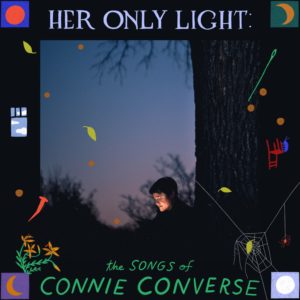
Her Only Light illuminates Connie Converse’s art songs and folk songs with Ronnie Kuller’s lush arrangements, featuring a 6-piece ensemble of violin, viola, cello, harp, and clarinets, who accompany vocalist Emmy Bean. Her songs encompass presence, absence, isolation, squirrels, childhood, the unknowable, the familiar, flowers, death, and disappearance. The album also includes selections from her Cassandra Cycle, a strikingly ambitious work which hints at what Converse might have accomplished with more time. Converse’s imagination and her disappearance from human society are the backdrop against which we are invited in to explore her musical world. Through these songs, we are called to acknowledge our divided selves, our disconnection, and to entertain the possibility of joy in our shared sadness.
The themes of Converse’s work all resonate deeply with many of the experiences we are sharing in this present moment; encroaching fundamentalism, fear-mongering, and the politicized commodification of human life are with us still, again, as ever. Her music has survived the silencing and marginalization of forces internal and external to her life and continues to reveal itself to us as tenderly and assuredly as ever. The playful and prophetic imagination of her songwriting and the worlds she imagined evoke mystery, humor, and pathos and call in unique forms of connection and commemoration.
When she said goodbye in 1974, Connie wrote, “Let me go, let me be if I can, let me not be if I can’t.” Poet Hanif Abdurraqib wrote with great compassion on the topic of her disappearance, and in his assessment, she was well within her rights to leave, to ask for what her family gave her: the freedom to be lost and unheard from. We treasure his reading of her work, and her life, as that of a fellow artist who always walked between worlds, like so many of us do.
We choose not to linger on the reasons why she left, and instead we celebrate her work. We are two of maybe a thousand other artists who would have held her hand as she slipped in and out of wanting to be alive. We remain, tied to one another in an invisible chain of belovedness, of wanting to be close, wanting to see and be seen. This chain, fortunately, does not break between worlds. It extends beyond each border and division of time and place and consciousness; it unites the living and the dead.
Our work celebrates her ghost, her livingness and her deadness, her humor and her pathos, all the parts of her that are in her songs. We are grateful to be among the many who engage in this work of celebratory remembrance each time we sing and play her music.
CREDITS
These songs were recorded at Lost Boy Studio in Chicago, IL in August of 2024. This month marked Connie Converse’s 100th birthday and the 50th anniversary of her disappearance. Mathieu Lejeune was our recording engineer, and Emma Hospelhorn was our music coordinator. Our ensemble was as follows:
Ronnie Kuller, conductor
Emmy Bean, vocalist
Sarah Plum, violin
Vannia Phillips, viola
Melissa Bach, cello
Lauren Hayes, harp
Emily Rach Beisel, clarinets
Katherine Jimoh, clarinet
All songs were composed by Elizabeth “Connie” Converse, with all texts by her except for “Anyone Lived in a Pretty How Town,” which takes its text from a poem by e.e. cummings. The project was supported by a grant from the DEW Foundation and the Chicago Department of Cultural Affairs and Special Events, and funding from 3Arts, as well as the contributions of many donors in our circle of friends and family. We are grateful to Dan Dzula and Howard Fishman for sharing their access to the original sheet music as well as for their guidance and support in allowing this project to take place. We also thank David Isaacson and Tim Converse for their support of our project and for sharing our work with those close to the Converse family. Her Only Light is a sponsored project of Fractured Atlas, a non-profit arts service organization.